-
 Being already the desire of most of our clients, the MINIBETON of 2 m3 capacity harvest the fruits of many years of experience of our technical research centre.
 -
 This is the smallest machine of the series. It has been developed to work on elements which do not need large quantities of concrete. Its particular handling and small dimensions allow to reach high translation speed.
 -

 The Combidrive MO is a cold rolling line with single horizontal drawing capstan for the production of smooth and ribbed wires in bars from Ø 4 to Ø 12 mm. This cold drawing line is completely modular and the rolling process is made through drawing capstan and rollers cassettes for rolling/profiling. Driven by electric asynchronous servomotors digitally controlled.
 -

 The Coldrive MV is a cold rolling line with single vertical drawing capstan for the production of smooth and ribbed wires from Ø 4 to Ø 12 mm. This cold drawing line is completely modular and the rolling process is made through drawing capstan and rollers cassettes for rolling/profiling. Driven by electric asynchronous servomotors digitally controlled.
 -
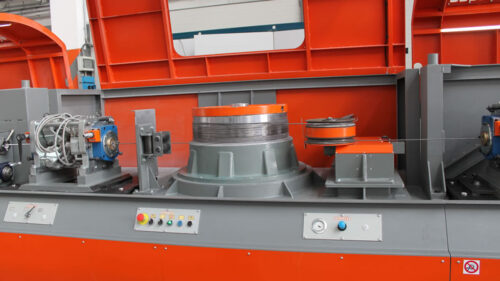
 The “Coldrive” 2MV is a cold rolling line with multiple vertical drawing capstan for the production of smooth and ribbed wires from Ø 3,4 to Ø 12 mm. This cold drawing line is completely modular and the rolling process is made through drawing capstan and rollers cassettes for rolling/profiling. Driven by electric asynchronous servomotors digitally controlled.
 -
 COIL SPIDER is a safe and small lifting device that, due to its up-to-date features, can hook from the outside rolled and drawn coils (either rewinded or not). COIL SPIDER is equipped with an automatic release and hiding guns (patented).
 -
 COIL FLIPPER is an efficient patented device for coil handling. Thanks to its innovative design, it can lift and rotate coils from the horizontal to the vertical position in one simple movement.
 -
 Cage making machine for the production of round cages with welded spirals and pre-set pitch. The machine is characterized by a reduced longitudinal length. The welding process is performed by a mobile unit and the bar loading zone is a telescope, for this reason, during the welding operation, the length decreases while the welding head moves forward. Unwinding pay-off Placed at the side of the machine’s body, it holds the coil that is going to produce the spiral. The pay-off moves together with the mobile disk where the welding machine has been placed. Ray Its aim is that of separating the bars that are going to produce the cage. The ray is hooked to the mobile disk, therefore it has the same rotating movement and it reduces itself while the welding head moves forward. Their function is to support the cage during its fabrication. They are raised automatically and stopped as soon as the supporting rollers reach the cage. Fixed plate Bored plate rotating in a synchronised way with the mobile plate; its clamps are used to secure the rebars. Mobile plate This plate is bored in the same way as the fixed plate. Once you have set the diameter of the cage you are going to produce, the bushes are placed and secured to the plate. The rebars fed through the dial are then made to slide through these bushes. Cages are produced by moving the mobile plate forward and forming a spiral around the rebars. Fixed plate Bored plate rotating in a synchronised way with the mobile plate; its clamps are used to secure the rebars. Mobile plate This plate is bored in the same way as the fixed plate. Once you have set the diameter of the cage you are going to produce, the bushes are placed and secured to the plate. The rebars fed through the dial are then made to slide through these bushes. Cages are produced by moving the mobile plate forward and forming a spiral around the rebars. The new CM PRO Telescope control is incorporated in the base structure so that the machine takes up less space, at the same time freeing the operator working area. It is fitted with a touch screen, flash memory, and provision has been made for a serial line. In addition, it allows changing the cage execution speed without interrupting the working cycle, producing cages with variable pitch, defining how many cross-pieces to weld and automatically lifting the supports.
 -

 Machine for the production of cylindrical cages with variable pitch welded spiral wrap (Ø 1600 mm). High productivity and flexibility is guaranteed by the configuration of the machine and by the fully automatic welding unit SAF 3000. It is also possible to produce on the machine square or rectangular cages and cages with the bars bent on the end (90° bends, bottle necks and pointed).
 -
The cage making machine CM PRO 110, produces cylindrical and prismatic poles with welded spiral and programmable pitch (Ø 1100 mm), but thanks to equipment with a set of servomotors, the new monobloc structure and other major innovations, it is a more flexible, faster, safer, innovative and transportable machine.
The rods located in the holes of these plates form dials which separate the rebars being fed to the machine to fabricate the cage. The dial is anchored to the fixed plate, thus following its rotation. It lies on the storage boxes by means of polyurethane-coated rollers located at one end of metal rods.
Their function is to support the cage during its fabrication. They are raised automatically and stopped as soon as the supporting rollers reach the cage.
Fixed plate
Bored plate rotating in a synchronised way with the mobile plate. Once you have set the diameter of the cage you are going to produce, the bushes are placed and secured to the plate. The rebars fed through the dial are then made to slide through these bushes.Mobile plate
Cages are produced by moving the mobile plate forward and forming a spiral around the rebars. The suspended mobile disk attached to the main structure and equipped with servomotors to give it greater accuracy and speed.Thanks to the suspended mobile disk, an innovative cage evacuation system with hydraulically-operated chutes could be designed and applied: a crane is no longer required to evacuate the cage and the machining cycle can immediately be resumed.
Thanks to the suspended mobile disk, an innovative cage evacuation system with hydraulically-operated chutes could be designed and applied: a crane is no longer required to evacuate the cage and the machining cycle can immediately be resumed.
The new CM 1100 xp control is incorporated in the base structure so that the machine takes up less space, at the same time freeing the operator working area. It is fitted with a touch screen, flash memory, and provision has been made for a serial line. In addition, it allows changing the cage execution speed without interrupting the working cycle, producing cages with variable pitch, defining how many cross-pieces to weld and automatically lifting the supports.
-
 IDEA assembles cages by means of the patented 'Schnell System' (Patented): using three thin longitudinal wires, which may be welded to any point of the stirrup's exterior surface IDEA is able to half-assemble lattice girders of stirrups of any shape and size. Its operation is extremely simple: stirrups are fed; next they are welded to the three longitudinal wires by the welding clamps; the whole girder is made to slide forward while its motion is previously set by the computer and may be constantly checked. The half-assembled girder is now ready to be finished off by fixing the frame carrying bars. Fixed welding unit. 3 welding heads each unit may be moved to different positions both in height and lengthwise and may rotate to reach the ideal welding point. The vertical positioning is performed by a gearmotor. Fixed welding unit. 3 welding heads each unit may be moved to different positions both in height and lengthwise and may rotate to reach the ideal welding point. The vertical positioning is performed by a gearmotor. Mobile traction unit. It consists of: 1 mobile head which is driven by an electronic motor along the girder supporting framework and is equipped with 3 vices to clamp/release the longitudinal wires. Girder traction frame. The pitch may be set on the computer. Central framework It consists of a supporting framework where the half-assembled lattice girder slides during manufacture and slides to remove assembled girders. Industrial computer mod. 'Idea-Control', designed to work in very harsh environments. It is equipped with an alphanumeric display and manages all the functions performed by the machine.
 -

 Software module that allows automatically importing the data of the longitudinal beam reinforcements according to the working drawings. The table must explicitly contain the drawing of the rods of these longitudinal reinforcements. CLIC-CAD recognises shapes, lengths and diameters of the reinforcement rods in the drawings and imports the data directly to our GO management software for the subsequent working procedures (cutting optimisation, label printing, sending the production data to the machines, reports, statistics, etc.). CLIC-CAD thus allows: -Drastically reducing the workload of those who convert the drawings into job lists - Reducing operator input errors.

